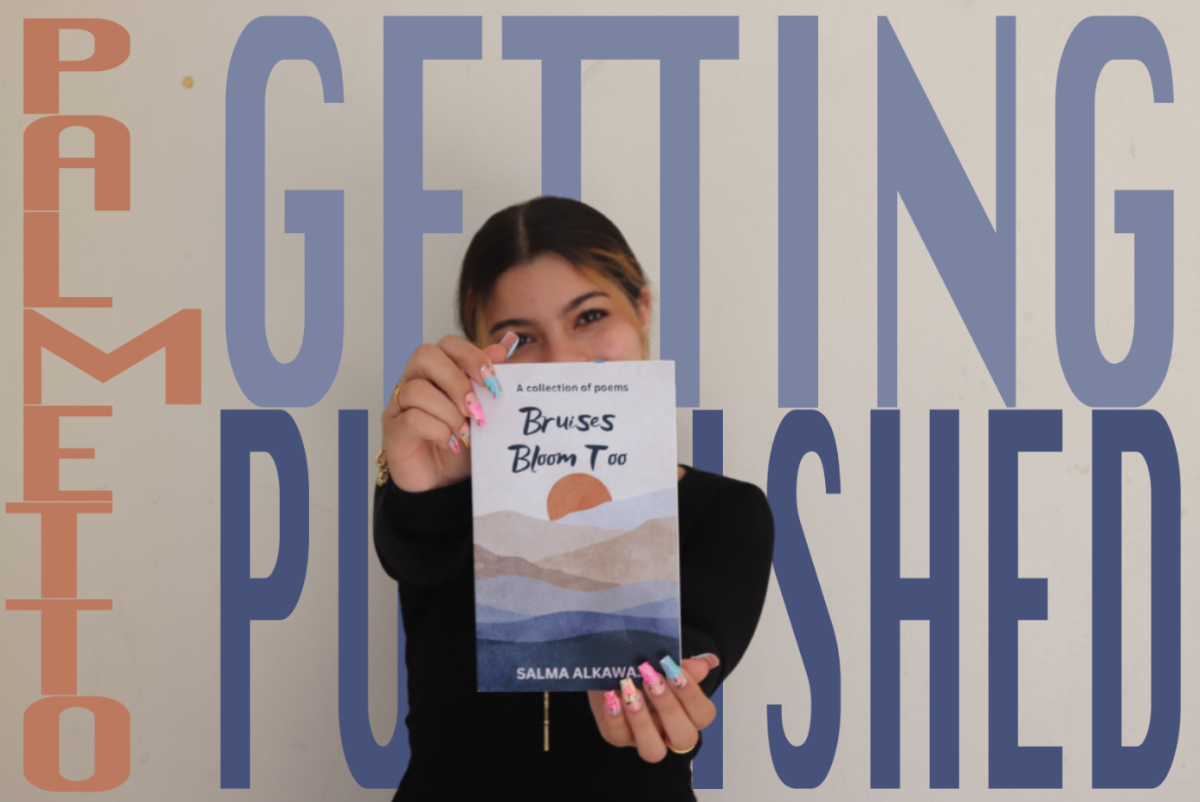
Many young writers dream of seeing their words shared with the world. For Miami Palmetto Senior High sophomore Salma Alkawaja and junior Victoria Enriquez, that dream has already become their reality.
Alkawaja wrote and self-published a book called Bruises Bloom Too, a story following the character Layla as she grows through high school. In this book, Alkawaja tackles themes of mental health, heartbreak and grief, all being tied together by the overarching theme of love.
The character of Layla is deeply personal to Alkawaja, with her portraying Layla as a mirror to the teenage mind.
“I think me and Layla do share some similarities in [the book], maybe how we feel a little bit, but I feel like she is more like a broader representation [of teenage culture],” Alkawaja said.
In Alkawaja’s mind, Layla resembles one of her favorite things, flowers. The title Bruises Bloom Too comes from the idea of Layla as a bud, with the bruising aspects being the struggles she faced in her high school years and the blooming like flowers were made to represent her perseverance and how she was able to move on.
Alkawaja went through a unique route to display her voice through this novel, writing Layla’s story through a collection of poems. Alkawaja has picked up the hobby of writing poetry and has taken part in it for about a year and a half. The funny thing about this book, though, is that Alkawaja never originally intended for it to become a book.
“Throughout freshman year, I was writing poems. I carried that a little bit into sophomore year, and then one day I was looking and I had all these poems, and I was like, ‘How cool would it be to have a book of [all of my] poems?’ So then I wrote more, and I tied them into the storyline,” Alkawaja said.
The idea of publishing a poetry book is bold, but Alkawaja received endless support from both her teachers and friends.
“They held me accountable,” Alkawaja said. “24/7 it was, ‘Salma, where are we at with the book?’”
When Alkawaja had finally embraced this idea, she dove head first into the world of publishing. When authors work with a larger publishing agency, they take care of most of the little aspects. However, when an author self publishes, they are forced to tackle all of those tiny decisions themselves.
“When you self publish, there’s a lot of tedious things that you have to think of, like the cover size, the dimensions, the book formatting and how the lines are spread,” Alkawaja said.
Just two months after the book’s release on Amazon, Alkawaja has received immense support from the MPSH community. Seeing people around school support the book has made the experience feel even more surreal.
“As soon as I published, I was like, wow. That’s crazy. My name is out there,” Alkawaja said.
Enriquez also went through the process of publishing a book through Amazon. Enriquez’s book, titled My Math Mess, is designed to introduce the learning disability of dyscalculia to elementary school students. Dyscalculia affects a person’s ability to understand numbers, calculations and numerous math concepts.
“The whole purpose of the book is to explain the symptoms, explain some remedies and then if you see the symptoms in your kid, [encourage parents to] get them tested,” Enriquez said.
Struggling with dyscalculia herself, Enriquez marketed the book toward children as an attempt to help them target symptoms of dyscalculia early on.
“When I found out [I had dyscalculia], I was in freshman year and there wasn’t really anything I could do about it,” Enriquez said. “There were already like a million books about it for adults, but most kids that get diagnosed early are in elementary school … and it can get really confusing if you are a little kid.”
Enriquez published the book last year as a part of her Girl Scout Gold Award Project. Enriquez’s project is an awareness campaign for dyscalculia, with the book just being one branch of her project along with a website and presentations at schools. Girl Scouts has been a central part of Enriquez’s project, helping her get her project off the ground and connecting her to others who could help her make this dream a reality.
For Enriquez, the book became more than just a Gold Award project. It became a way to help younger students understand dyscalculia earlier than she was able to herself.
Although Alkawaja and Enriquez wrote about two very distinct experiences, both students used their books as a way to turn something personal into something that could help others. By publishing their stories while still in high school, they have achieved what so many young writers strive to do: share their words with the people who may need them most.