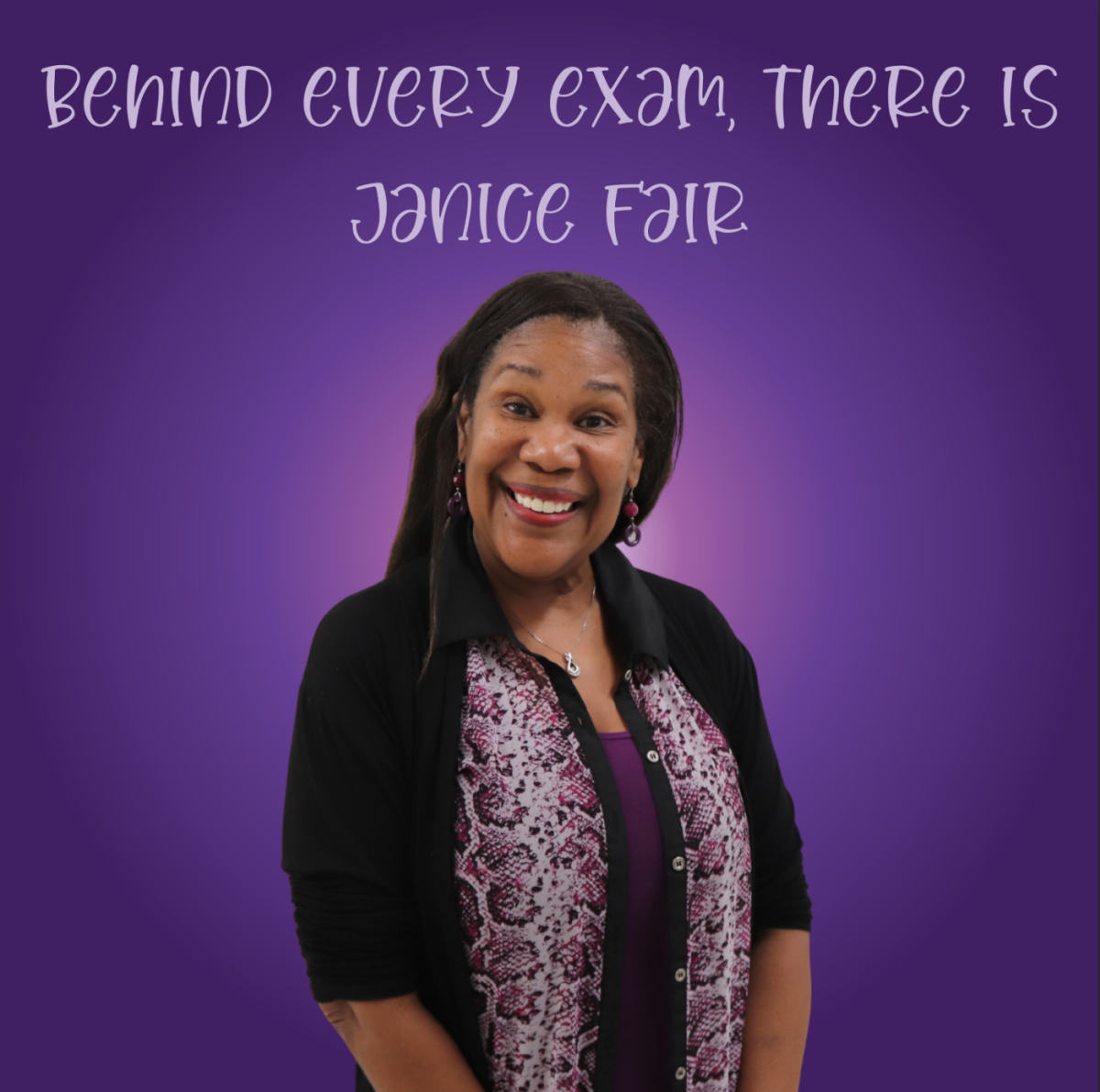
Each testing season, as many students cram in final study sessions, willing their brains to store content in their long-term memory, Janice Fair spends long hours at Miami Palmetto Senior High setting up testing materials so students can successfully finish off the school year. Working at MPSH since 2008, Fair wears many hats around the school, completing crucial behind-the-scenes tasks that do not cross the typical Panther’s mind.
From early morning drives to packing up after long days of testing, Fair has spent 18 years working at MPSH, and these two to three weeks in May are always her busiest, yet often reflect a hard year’s work. Fair currently serves as the school’s Advanced Placement Coordinator, Reading Department Chair, Services for Students with Disabilities Coordinator and Liaison for the ACT and College Board and At-Risk Coordinator. She has taken on these positions gradually throughout her years at MPSH, where she initially began as a reading teacher.
Fair took on many of these positions for convenience, as her responsibilities cross different departments and require access to specific data. For example, Fair became the school’s College Board Liaison so she could more effectively organize AP exam scheduling, especially for AP students with accommodations, as the AP Coordinator. Nonetheless, while many of her positions are intertwined, they do not come without their challenges.
“It’s just it could be stressful beyond belief sometimes, because there are details for every little [AP] exam, like, for example, [the] Japanese and Chinese [exam] that are online, I had to go and talk to our IT tech to find some devices for those kids to download,” Fair said. “And then I had to make sure the headphones work, and now Computer Science Principles, those kids have what we call a PPR, personalized reference sheets, that now have to be in color. Have to print those out and match them up to each student. Every single test requires something different, and it’s a lot.”
Despite these details, which require organization and precision, Fair’s work at the school has allowed her to make an impact on students’ lives and form tight-knit relationships with other Panthers. Most notably, Fair believes she connects most with the students in the at-risk program.
“These are seniors who are at risk of not graduating every single year, and I’m getting teary-eyed just thinking about it,” Fair said. “I just had one girl yesterday — I just administered the SAT, which we call non-college reportable, and it’s only for kids who are seniors. They need a test, but the state will take it as a graduation requirement … She has her GPA, she has her credits, but she just could not pass any state test. But you can take the ACT, the SAT or the CLT, which is what I do, and use it as a concordance score to replace it. I called her in — Dr. Hunter and me yesterday — and told her she passed both parts. [We] cried and bawled like a baby. So I find that so rewarding.”
Moreover, Fair has witnessed many journeys and chapters evolve. Whether it be assisting with the transition to digital testing, something Fair found very successful and believes will dominate the future of standardized testing, or working alongside her son, security guard Trevon Hughes, Fair knows that there is always something around the corner. For her, this means retirement, and she will spend the next school year training replacements for her various jobs around the school. Once she retires, Fair plans to settle down in her family’s hometown of Virginia.
Fair’s journey has involved a lot of change, allowing her to switch positions and try new things, even if they were not what she predicted. While many students find high school difficult and struggle to look beyond their current chapter, Fair urges them to remain confident in life’s pacing.
“I try to let them know that there’s life after high school. There is a life after high school, you’re going to go on and you’re going to do things that you want to do. But it starts here, so let’s get you to graduate at least,” Fair said. “And then you’re going to think back on high school and say, ‘Wow, I wish I could have done this’ or ‘That teacher was so right when they said that.’”