

Since the invention of the atomic bomb in 1945, the world has feared the consequences of an all-out nuclear attack. At the time, no one was sure what would happen if opposing countries turned against each other, and international tensions were extremely high. To soothe these fears, the Doomsday Clock was created and set at seven minutes to midnight.
The Doomsday Clock is a hypothetical signal designed by the Manhattan Project scientists, including J. Robert Oppenheimer and Albert Einstein. Its first appearance was in the Bulletin of the Atomic Scientists, an academic journal founded by those same experts. The Bulletin’s Science and Security Board, made up of Nobel Prize winners, professors and international experts on global security, decides where the clock should be set each year. Their evaluation takes into account current political tensions, technological advancements and environmental risks, making the clock a reflection of both human actions and scientific understanding.
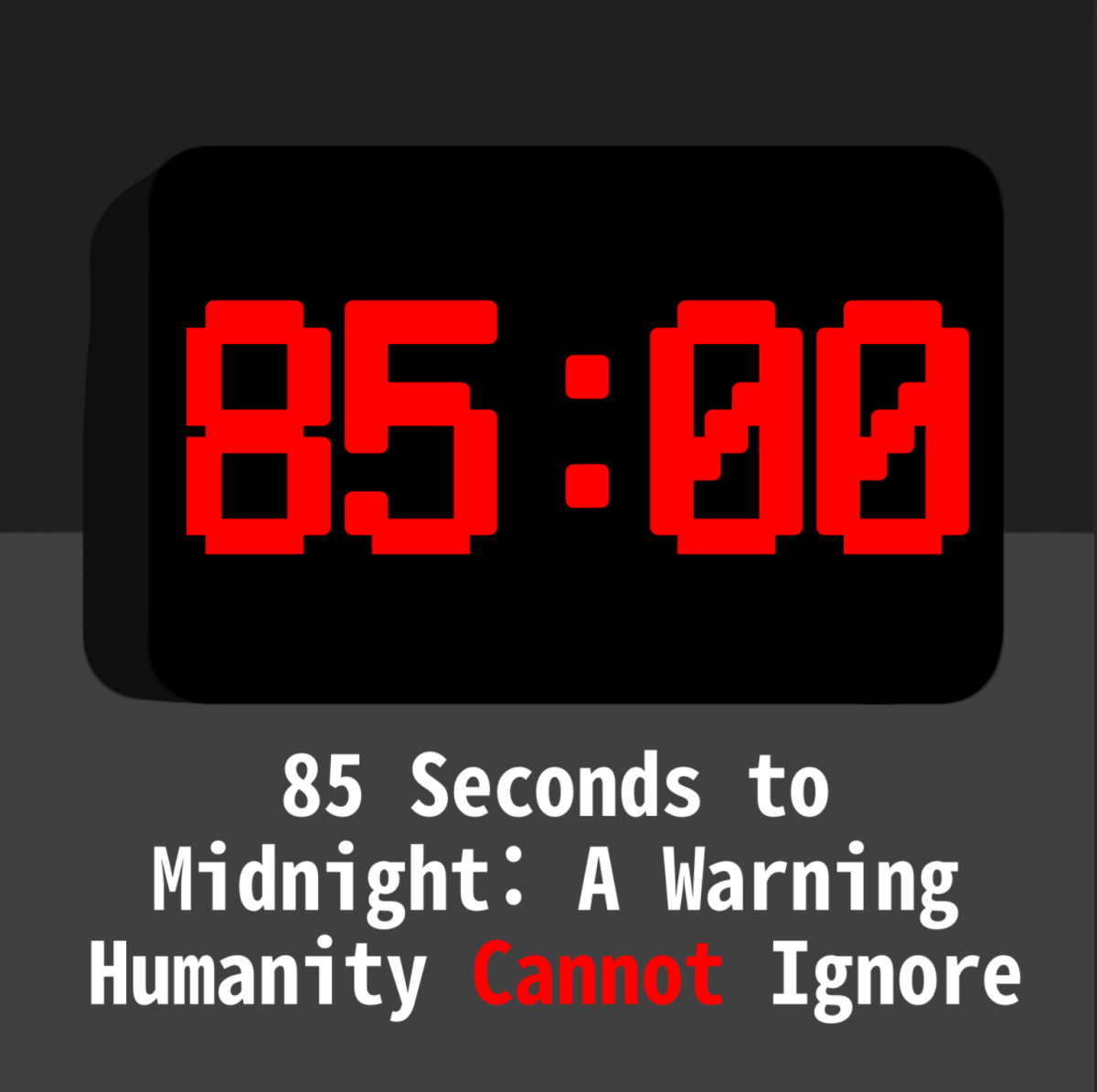
In terms of timing, the closer the clock is to midnight, the closer Earth and humanity are to being destroyed by their own creations. Originally, only nuclear war was considered serious enough to warrant these fears. In recent times, however, advances in ideas such as climate change and Artificial Intelligence have fueled anxieties. Currently, the clock is set at 85 seconds to midnight, the closest it has been since 1947. This unprecedented proximity to midnight indicates the urgency experts feel regarding current global challenges.
Increased tensions between the world’s major superpowers, as well as emerging threats, have been cited as causing the recent shift. The Board has stated that instead of cooperating, many countries have become “increasingly aggressive, adversarial and nationalistic.” The Israel-Gaza conflict, the Russia-Ukraine War and the Iran War have caused concern among most people, and the clock serves as a representation of that fear.
Although the Doomsday Clock is only a symbol, it provides a serious message. The closer it ticks toward midnight, the more urgently scientists believe humanity must act to save itself. Whether through preventing nuclear war, slowing climate change or regulating artificial intelligence, the clock is a warning that the future of the world depends on the choices people make today.